Slips, Trips, and Falls

  • Home
  • Slips, Trips, and Falls
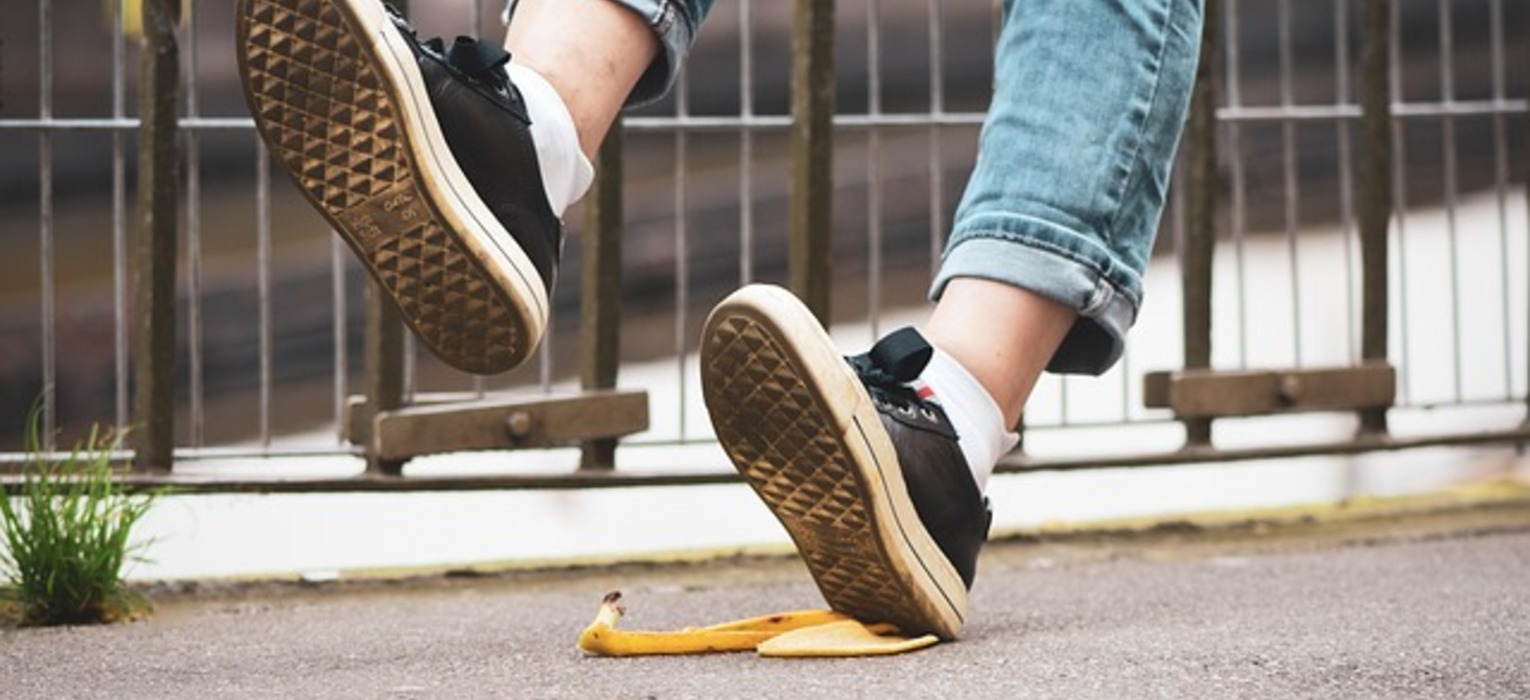
Person's foot slipping on a banana peel, illustrating the hazards of slips, trips, and falls in workplace environments.
Slips, Trips & Falls | Safety Is A Mindset
Safety Is A
Mindset
Workplace SafetyOSHA 29 CFR 1910safetyisamindset.com
#1 HazardNon-Fatal Workplace Injuries · OSHA Priority

Slips. Trips.Falls.

They happen in a fraction of a second. They put workers out for weeks, months, or permanently. At Safety Is A Mindset, we know the data — and we know that almost every one of these incidents was preventable. Not with better floors. With better habits.

Estimated U.S. Workplace STF Cost — This Year

$0

Based on $70B+ annual burden. Counter runs in real-time from Jan 1 of current year.

Live estimate · updating every second
$70B+Annual cost of slip, trip & fall injuries in U.S. workplaces — direct and indirect costs combined
27%Of all non-fatal occupational injuries are caused by STFs — the single largest injury category
865Fatal falls in U.S. workplaces recorded in 2022 — same-level and elevated combined (BLS)

Self-Assessment Tool

Is Your Workplace
a Fall Hazard?

Use this quick walkthrough audit — built from OSHA's STF inspection criteria — to identify existing hazards in your workspace. Check every box that's currently in place. Safety Is A Mindset uses tools like this to start real conversations, not just generate compliance paperwork.

STF Hazard Audit

Check items that are currently in place in your workplace

0/ 20

🏢 Floors & Surfaces

🚶 Walkways & Aisles

🪜 Stairs & Ramps

🧠 Behaviour & Culture

Root Cause Analysis

Three Causes.
One Mindset Fix.

Every slip, trip, or fall traces back to one or more of three root categories. Safety Is A Mindset teaches workers to see their environment through this lens — identifying hazards before they create incidents.

Surface Condition

Slips — The Friction Deficit

A slip occurs when there is insufficient friction between a foot and the walking surface. Wet floors, polished tiles, spilled liquids, loose mats, ice, and wet grass all create slip conditions. The critical element: most slip hazards are temporary and entirely preventable through housekeeping discipline, surface choice, and footwear policy. Workers who understand the physics of friction see risk differently — they scan for shine, for wet tracks, for humidity. This is the safety mindset in practice.

Stop asking "who spilled that?" and start asking "why wasn't it cleaned up in 60 seconds?" Speed of response is your primary slip defense.

Path Obstruction

Trips — The Hidden Edge

Trips occur when a foot strikes an unexpected object or surface change — a raised mat edge, an unmarked step, a box left in an aisle, a cable across a walkway, or an uneven threshold. Unlike slips, many trips happen at normal walking speed with full traction. The hazard is invisibility: workers travel familiar routes on autopilot, and the object that was never there before breaks the pattern. Safety Is A Mindset training re-activates conscious visual scanning on familiar paths — the single most underestimated behavioral intervention for trip prevention.

Familiarity breeds complacency. The most dangerous aisle is the one you've walked 500 times without incident. It will be different on walk 501.

Elevation Change

Falls — The Elevation Risk

Falls from elevation — ladders, platforms, loading docks, mezzanines, rooftops — are where STF incidents become fatalities. But same-level falls are not benign: hip fractures, traumatic brain injury, and spinal damage occur from falls at walking height. The elevation cause category covers both the physical guardrail gap and the behavioral gap — the decision to work at height without proper fall protection, to skip the safety harness, to trust a worn ladder rung. The equipment is the last defense. The safety mindset is the first.

Every elevated surface is a hazard in waiting. The question is never "do I need fall protection here?" It's "what fall protection is this task-specific situation right for?"

The Business Case

The True Cost of
a Single Fall Incident

OSHA / NSC Research — Direct + Indirect Costs

$38,000
$150,000+

The direct cost of a single lost-time STF incident ranges from $38,000 for a minor injury to over $150,000 for a serious fall. But OSHA's research consistently shows that indirect costs — lost productivity, retraining, investigation time, insurance impact, morale damage, and regulatory penalties — multiply the direct cost by 4 to 10 times. A single serious fall can cost a small employer over $1 million in total impact. This is the business case for investing in a safety mindset before the incident.

Average Lost Workdays11 days

Per STF incident — the longest of any workplace injury category (BLS 2022)

Workers' Comp Premium Impact3–5×

Multiplier effect on insurance premiums following a serious STF claim — lasting 3+ policy years

OSHA Maximum Penalty$156,259

Per willful or repeated violation related to walking-working surfaces (29 CFR 1910 Subpart D, 2024)

Prevention Investment ROI$3–$6

Return for every $1 invested in STF prevention programmes — NIOSH and NSC research consensus

Control Strategies

Prevention That
Actually Works

The hierarchy of controls applies directly to STF prevention. Engineering first. Administration second. Behaviour third. Safety Is A Mindset addresses all three — because real STF elimination requires all three working together.

Engineering Controls — The Permanent Fix

Replace hazardous surfaces with slip-resistant flooring. Install permanent drainage in wet work areas. Eliminate level changes with ramps. Add fixed guardrails to all elevated platforms. Engineering controls are the gold standard — they protect every worker on every shift without requiring behavioral compliance. At Safety Is A Mindset, we teach workers to advocate for engineering solutions before accepting administrative workarounds.

Housekeeping as Safety

Spill response within 60 seconds. Aisles cleared at shift end. Floor inspections on schedule. Housekeeping isn't janitorial — it's safety-critical behaviour that needs ownership, not delegation.

Footwear Policy

Slip-resistant footwear rated for your specific surface and industry is a non-negotiable control. The same boot that works on concrete may be dangerous on a polished tile. Test, specify, enforce.

Lighting Standards

Inadequate lighting creates invisible trips. OSHA requires minimum 5 foot-candles in work areas, 3 in corridors. Emergency lighting must function on power failure. Glare and shadow are underestimated STF contributors — assess lighting quality, not just quantity.

The Mindset Layer

No physical control replaces conscious hazard awareness. Workers who've internalized the safety mindset scan their path, report near-misses, and speak up when conditions are unsafe — even under production pressure.

After an Incident

The Investigation
That Prevents the Next One

An STF incident investigation is not a blame exercise — it's a system diagnostic. Safety Is A Mindset trains supervisors to run investigations that answer the question "what allowed this to happen?" — not "who caused it?"

Immediate Response

Ensure medical care. Preserve the scene. Do not clean or alter the area before the investigation begins. Photograph immediately from multiple angles and distances.

Scene Documentation

Photograph and measure. Note lighting, floor condition, housekeeping state, signage presence. Collect all environmental factors — weather, shift timing, noise levels, recent maintenance activity.

Witness Interviews

Interview witnesses promptly and separately. Use open questions. Focus on what was observed, not on blame assignment. Psychological safety during investigation determines report quality.

Root Cause Analysis

Apply 5-Why or Fishbone analysis to identify root causes — not just immediate causes. "The floor was wet" is the symptom. "No spill response procedure exists" is the root cause.

Corrective Actions

Assign corrective actions with named owners and deadlines. Prioritize engineering controls. Track completion. Without assigned accountability, corrective actions become a list — not a fix.

Communicate Findings

Share the investigation findings with the whole team — anonymised if needed. What was found. What's being fixed. What everyone can do differently. This is how one incident prevents ten.

Verification & Close-Out

Verify that corrective actions were implemented effectively, not just completed. A new mat installed but not anchored at the edges fails the same way as no mat. Close the loop — document, date, sign.

Safety Is A Mindset

STF hazards connect to almost every area of workplace safety. These pages from Safety Is A Mindset extend your understanding from the floor to the full safety culture.

Safety Is A Mindset

Common Questions

STF
Answered.

From facilities managers auditing their floors to workers questioning their footwear — these are the questions that come up most in Safety Is A Mindset's slips, trips, and falls training sessions. Direct answers. No padding.

The distinction matters because each has different causal factors and different prevention strategies. A slip is a loss of traction — the foot slides on the surface, typically due to a friction deficit caused by contamination, surface condition, or footwear. A trip is a loss of balance caused by contact with an unexpected object, obstacle, or surface irregularity — the foot catches while the body continues moving. A fall is the result: the loss of upright posture that sends a person to a lower level or to the ground. They can occur independently — you can slip without falling if you catch yourself — or in combination. Identifying which category an incident falls into directs you to the right investigation and corrective action. Investigating a trip as a slip hazard produces the wrong fix entirely.
The standard measure is the Coefficient of Friction (COF) — the ratio of the force required to slide an object across a surface to the weight of that object. The ANSI/NFSI B101.1 standard recommends a wet static COF of at least 0.60 for walkways and 0.80 for ramps. These measurements are taken using a tribometer — a device that drags a standardized rubber pad across a wet surface and measures the resistance. Floors that look non-slip may have very different COF values depending on contamination, cleaning chemicals used, wear patterns, and product residue. COF testing is inexpensive, objective, and provides documented evidence that floors meet the standard — invaluable both as a prevention tool and in OSHA or litigation situations. Safety Is A Mindset recommends COF testing at lease annually and after any flooring change or new cleaning product is introduced.
Winter multiplies every STF risk factor simultaneously. Outdoor walking surfaces become ice-covered or wet with snow melt. Workers tracking moisture inside create contaminated entry-point floors. Cold temperatures stiffen footwear soles, reducing grip. Workers wearing bulkier clothing have altered gait and reduced peripheral vision. Reduced daylight creates shadow and visibility problems in parking lots and exterior paths. Shorter days mean more shift changes in darkness. Workers hurrying in cold conditions take shortcuts in their movement patterns — not scanning properly, rushing through hazardous transitions. Safety Is A Mindset's seasonal STF programmes specifically address the winter cluster — with toolbox talks, enhanced inspection schedules, and visible reminders at building entrances that integrate naturally into existing team safety culture.
Same-level falls are genuinely dangerous and dramatically underestimated in terms of severity. The CDC reports that same-level falls account for the majority of STF-related hospitalizations, particularly among workers over 45. A walking-height fall can result in hip fractures (especially in older workers, with mortality rates of 20–30% within a year of a hip fracture), traumatic brain injury from head contact with hard surfaces, wrist fractures from instinctive outstretched-hand reactions, and spinal injury depending on landing mechanics. Falls from height generate higher fatality rates — but same-level falls generate far higher injury volume and are responsible for the majority of lost-time days across all industries. The safety mindset treats same-level falls with the same seriousness as any other fall hazard — because the injury statistics demand it.
STF near-misses include: slipping but catching yourself on a handrail; stumbling over an object but not falling; a sudden foot slide that doesn't result in contact with the floor; stepping on an unseen hazard and losing balance momentarily. These events are extraordinarily common — and almost universally unreported. Workers often dismiss them as "nothing happened" or feel embarrassed. But every near-miss contains the exact same causal chain as the incident that will eventually occur — only the outcome was different. Heinrich's Triangle and later research confirm that for every serious STF incident there are dozens of near-misses involving the same underlying hazard. Reporting and investigating near-misses is your highest-yield STF prevention activity. Safety Is A Mindset builds the psychological safety and reporting systems that make near-miss reporting feel normal, not shameful.
Distraction is a primary behavioral contributor to STF incidents — and it's escalating as mobile device use in workplaces increases. Walking while looking at a phone, carrying loads that obscure the path ahead, rushing to meet production pressure, mental preoccupation with other tasks, and fatigue-induced inattention all reduce the perceptual scanning that identifies hazards in time to avoid them. Research shows that even a brief moment of divided attention reduces walking stability and hazard detection significantly. The behavioral intervention is conscious attention redirection — training workers to treat walking as a safety-critical task requiring full attention, particularly in transition zones (doorways, stairs, dock edges, loading areas) where hazards concentrate. Safety Is A Mindset's STF behavioral training uses habit-stacking techniques: teaching workers to trigger a "hazard scan" reflex at specific environmental cues, making it automatic rather than dependent on remembering to pay attention.
Standard STF compliance training tells workers to watch where they're going, clean up spills, and report hazards. It meets the regulatory requirement. It rarely changes what happens at 2pm on a Tuesday when someone's distracted and the floor's wet. Safety Is A Mindset training starts with the same content but builds toward a different outcome: internalised hazard recognition that doesn't require someone to consciously remember a rule. We focus on why the eye-to-floor scanning reflex degrades on familiar routes. We address the social dynamics that make workers hesitate before pointing out a colleague's unsafe behaviour. We give supervisors the language to conduct effective post-incident conversations that identify system failures without triggering defensiveness. And we build near-miss reporting into the team's regular rhythm — so the safety signal reaches prevention before it reaches the incident register. The result isn't a workforce that knows more about STF. It's a workforce that moves differently, notices more, and speaks up sooner.

Format: Online Interactive

Tier: 2

Course ID: 3363

Languages: English, Spanish, Korean, Russian, Thai, Chinese (Simplified), French, German, Hindi, Polish, Brazilian Portuguese

Get Started with Safety Is A Mindset Training

Complete the form below to request more information, schedule your training, or ask questions about any of our professional safety programs. Let us help you take the next step toward a safer and more compliant workplace.