




Uncontrolled hemorrhage is the leading cause of preventable death in trauma situations. Not cardiac arrest. Not airway obstruction. Bleeding — specifically, severe bleeding that trained bystanders could have stopped in the minutes before emergency medical services arrived.
The military learned this lesson in combat. Data from conflicts in Iraq and Afghanistan showed that a significant percentage of battlefield deaths from extremity wounds were survivable with immediate tourniquet application. That finding reshaped military trauma protocols, drove the development of modern hemorrhage control techniques, and eventually produced the Stop the Bleed campaign — a national initiative to bring those same life-saving skills to civilians in workplaces, schools, and public spaces.
The gap between a severe bleeding injury and EMS arrival is where bleeding control training matters. In urban areas, EMS response averages 7–10 minutes. For severe arterial bleeding, a person can lose a fatal volume of blood in 3–5 minutes. Trained bystanders who act immediately bridge that gap. Untrained bystanders who wait for professionals to arrive often watch someone die from an injury that was survivable.
How Severe Bleeding Kills — And Why Immediate Intervention Changes the Outcome
Severe bleeding causes death through hemorrhagic shock: the progressive collapse of the circulatory system as blood volume drops below the threshold needed to maintain organ perfusion. The process is rapid with arterial bleeding — the high-pressure blood loss from severed arteries can reach fatal volumes faster than most people realize — and somewhat slower with venous bleeding, but both can be fatal without intervention.
The physiological cascade of hemorrhagic shock — dropping blood pressure, increasing heart rate, altered consciousness, organ failure — is largely irreversible once it advances past a certain point. The intervention window is early, and it belongs to whoever is present at the scene, not to the paramedics still in transit.
This is why AVIRT training integrates hemorrhage control alongside active violence response protocols. Active shooter incidents, workplace accidents, and traumatic injuries all produce the same medical emergency: severe bleeding requiring immediate intervention. The training that prepares someone to respond to an active violence incident is incomplete without the medical skills to manage what that incident leaves behind.
The Three Core Bleeding Control Techniques
Professional bleeding control training — including the Stop the Bleed curriculum integrated into AVIRT and our certified first aid programs — covers three primary intervention methods, each appropriate for specific wound types and locations.
Direct Pressure
Direct pressure is the first intervention for most bleeding wounds. Place hands — gloved whenever possible — directly on the wound and apply firm, continuous pressure. Do not lift hands to check the wound. Do not remove blood-soaked dressings — add more material on top and maintain pressure. This technique is appropriate for wounds where tourniquet application is not feasible, including torso, neck, and groin injuries.
The most common failure with direct pressure is inadequate force and premature release. Training builds the physical confidence to apply the pressure needed and maintain it for the duration required — typically a minimum of three minutes for serious wounds.
Wound Packing
For deep wounds — particularly junctional wounds in the groin, axilla, or neck where tourniquets cannot be applied — wound packing with hemostatic gauze is the standard of care. The technique involves packing gauze directly into the wound cavity with firm pressure, filling the space to create the pressure needed to stop bleeding from deep vessels.
Wound packing is counterintuitive. It requires deliberately inserting material into a wound rather than simply covering it — an action that runs against instinct and that requires specific training to perform correctly under stress. Hands-on practice with realistic wound simulators is the only way to build the confidence and muscle memory this technique requires.
Tourniquet Application
Tourniquets are the definitive intervention for life-threatening extremity bleeding. Modern commercial tourniquets — the CAT (Combat Application Tourniquet) and SOFTT-W are the most widely used — can be applied in under a minute by trained individuals and are effective for both arterial and venous hemorrhage from arm and leg wounds.
Correct application requires specific technique: placement 2–3 inches above the wound, tightening until bleeding stops, securing the windlass, and noting the time of application for handoff to EMS. Incorrect application — too loose, too low, or improperly secured — fails to stop bleeding while delaying other interventions.
Training emphasizes one-handed self-application as well as application on others — a skill that matters for workers in isolated environments or situations where the injured person must act on their own injury before help arrives.
Workplace Applications: Who Needs This Training
Bleeding control training is relevant wherever traumatic injury is possible — which is everywhere. But certain industries and environments carry elevated risk that makes formal training particularly critical.
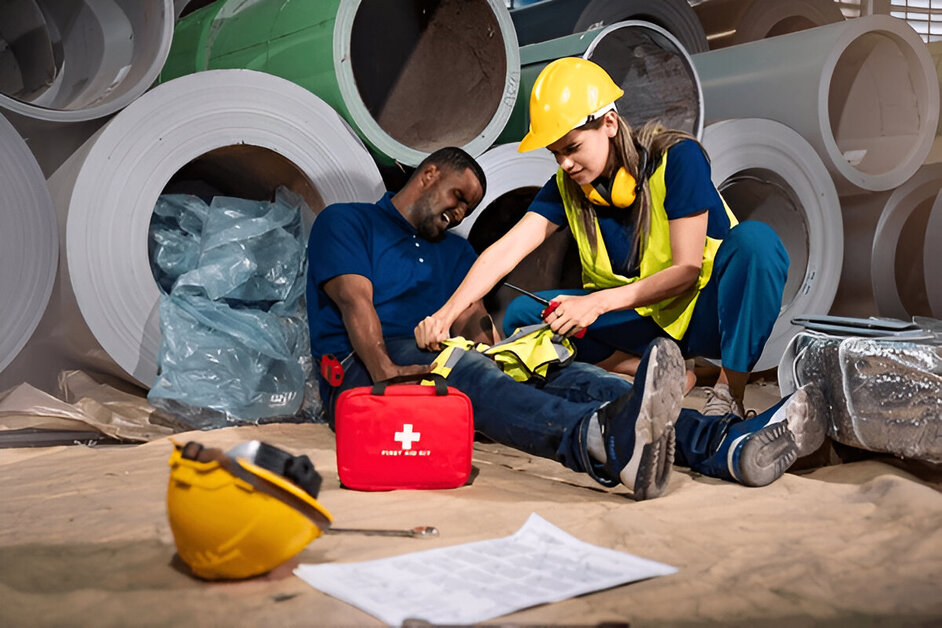
In manufacturing and construction, machinery, cutting tools, and heavy equipment create regular traumatic injury risk. Severe lacerations, degloving injuries, and crush injuries involving significant blood loss are documented occurrences in these environments. Having trained personnel on every shift — not just a designated first aid officer — dramatically reduces the time between injury and effective intervention.
In warehousing, forklift incidents and equipment-related injuries produce trauma with significant hemorrhage risk. In oil and gas and mining, remote worksites with extended EMS response times make on-scene bleeding control capability not optional but essential — in some locations, trained bystanders are the only medical response available for 20–30 minutes after an injury.
In transportation, vehicle accidents involving commercial drivers can produce severe injuries in locations where EMS response is delayed. In retail and hospitality, public-facing environments carry both injury risk and the possibility of violence-related trauma.
In schools and higher education, bleeding control training for staff provides life-saving capability for both accident injuries and active violence scenarios. In healthcare and banking, where active violence risk is elevated, integrating hemorrhage control with active violence response training produces teams prepared for both the threat and its medical consequences.
The power and utilities sector and municipalities both operate environments where traumatic injuries and active violence scenarios require the same immediate medical response capability.
We train 16 industries with programs that integrate bleeding control into broader safety and active violence preparedness frameworks.
Integration With Comprehensive Emergency Response Training
Bleeding control training is most effective as part of a layered emergency response capability, not as a standalone course. The medical skills that address hemorrhage connect directly to the broader emergency preparedness programs that address the full range of crises organizations face.
CPR and AED certification addresses cardiac emergencies — including those triggered by traumatic blood loss and shock. Hemorrhage control and CPR together prepare teams for the two most time-critical medical emergencies: uncontrolled bleeding and cardiac arrest. Both have narrow intervention windows. Both require trained bystanders to act before EMS arrives.
Basic first aid training covers the broader range of medical emergencies — fractures, burns, respiratory distress, anaphylaxis, stroke — that complement hemorrhage control and CPR skills. Organizations that build all three capabilities create emergency response teams prepared for the full spectrum of medical crises their environments produce.
AVIRT training integrates hemorrhage control directly with active violence response — the same program that builds Run-Hide-Fight decision-making also builds Stop the Bleed capability, so participants are prepared for both the threat and its medical consequences in a single training investment. See our AVIRT vs. traditional safety training comparison for a detailed breakdown of what this integrated approach includes.
OSHA 10 and OSHA 30 training provide the hazard identification and regulatory compliance foundation that informs where bleeding control training is most needed within a facility. Organizations that understand their injury risk profile — the specific equipment, workflows, and environments that produce traumatic injury — can target training investments more effectively.
Browse our complete course library for the full range of medical response and safety training available.
Equipment: Training Without Supplies Is Incomplete
Bleeding control training without accessible, well-maintained equipment is preparation without the tools to act on it. Every organization that invests in training should also ensure the right supplies are available where injuries are most likely to occur.
Bleeding control kits — stocked with commercial tourniquets, hemostatic gauze, pressure bandages, gloves, and trauma shears — should be positioned throughout the facility with the same logic applied to AED placement: close enough to reach within two minutes of any location where a serious injury could occur. Locked supply rooms or distant first aid stations defeat the purpose of having trained personnel.
Training covers equipment selection, proper use, inspection, and replacement. A tourniquet that has been improperly stored, expired, or damaged may fail at the moment of application. A hemostatic dressing past its shelf life may not perform as expected. Equipment maintenance is not a procurement task — it is a safety responsibility that requires the same attention as the skills training itself.
The Psychological Component: Building Confidence to Act on Severe Injuries
Severe traumatic injuries are visually and emotionally confronting in ways that routine first aid is not. The natural human response to a severe bleeding wound — hesitation, nausea, shock — is well-documented and completely understandable. It is also, in a life-threatening emergency, potentially fatal for the injured person.
Bleeding control training addresses this psychological barrier directly through repeated exposure to realistic wound simulators and scenario-based practice. Participants who have practiced wound packing on a realistic training model have a reference point that overrides initial hesitation when a real injury occurs. The action is familiar — the hands know what to do even when the mind is still processing the situation.
This stress inoculation is the same principle underlying all scenario-based emergency training. It is why in-person, hands-on training produces different outcomes than awareness-only programs. Knowledge that bleeding control is possible does not produce action under stress. Practiced skill does.
Building confidence to act — not just awareness that action is possible — is the central goal of bleeding control training, and it is a goal that requires hands-on practice to achieve.
Certification and Ongoing Competency
Bleeding control certification requires demonstration of correct technique — not just knowledge of the steps. Most programs provide certification valid for two years, with renewal required to maintain current skills. Techniques and equipment evolve as clinical evidence accumulates, and recertification ensures trained personnel are working with current protocols.
Organizations that schedule regular refresher training alongside other safety certifications — CPR renewal, OSHA refresher training, AVIRT recertification — build sustained capability rather than a one-time training investment that degrades over time. The value of certification is the current competency it represents, not the credential itself.
Get Bleeding Control Training for Your Team
Every workplace, school, and organization has people worth protecting from preventable death. Bleeding control training is one of the highest-impact investments in that protection — a relatively brief training commitment that produces a capability with direct, measurable effects on survival outcomes.
Contact Safety Is A Mindset to discuss bleeding control training as part of a comprehensive safety program for your organization. Our onsite training services deliver hands-on instruction at your facility, integrated with AVIRT, CPR certification, and first aid training for a complete emergency medical response capability.
Call: (870) 532-8278 Email: info@safetyisamindset.com
Comments are closed