
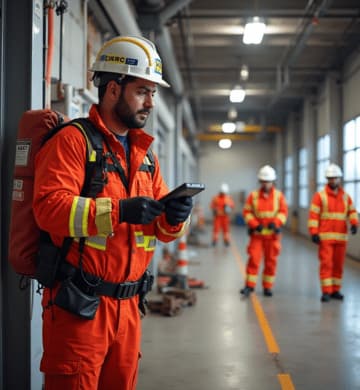
AVIRT for Heavy Industry
AVIRT Training for Industrial Workplaces and Heavy-Industry Sites
Industrial complexes already rehearse fires, releases and evacuations. AVIRT training for industrial workplaces fills the one gap those plans rarely cover: a person who intends to hurt others, inside the fence.
- HSI Authorized Training Center
- AHA Certified Instructors
- OSHA Outreach Training
- Navy Corpsman Instructor
- Onsite & Online Training
Where Existing Emergency Plans Fall Short
Steel and metal mills, chemical plants, paper mills, cement plants, foundries and large fabrication yards tend to have mature emergency programs. They have alarm tones for fire and toxic release, wind socks, muster points, headcount procedures and often an onsite emergency response team. Those plans are designed for hazards that behave predictably. An attacker does not.
The clearest example is the muster point. In a fire or release, sending everyone to one well-known location is exactly right. In an active violence incident, that same location can put the entire workforce in one place that a person with a grudge already knows. Active Violence Immediate Response Training helps industrial sites think through those conflicts and practice the right response for each kind of alarm.
The HSI course runs about four hours and covers recognition, decision-making, communication and bleeding control. For heavy-industry clients, we spend much of the scenario time on large sites, contractor populations and the interaction with process safety procedures.
Process Emergencies vs. Active Violence: Same Site, Different Rules
Reviewing your plan element by element shows where active violence needs its own instructions.
| Plan element | Fire or chemical release | Active violence incident |
|---|---|---|
| Alarm | Distinct tone, site-wide | Needs its own signal or code so people do not run toward muster |
| Gathering | Assemble at muster points for headcount | Disperse, shelter or leave the site; regroup later at a safe location |
| Shelter-in-place | Seal the room against vapors | Lock or barricade the room against entry |
| Site ERT | Leads the response | Supports medical care once the area is safe; coordinates with police |
| Gate control | Admit emergency vehicles | Stop entry, guide police and EMS to the right location |
Features of Industrial Sites That Shape Training
-
Huge footprints
Units, warehouses and control rooms may be far apart, and help on foot can be many minutes away.
-
Large contractor crews
Turnarounds and outages bring in workers who may not know the alarms or exits.
-
Control rooms
Operators cannot always walk away. Plans must account for safely securing or leaving the process.
-
PPE and noise
Respirators, hoods and hearing protection make shouted warnings ineffective.
-
Gatehouses and badges
Access control helps, but former employees and contractors may still know the routines.
-
Onsite responders
ERT members and medics can deliver care sooner than outside EMS once it is safe to do so.
Including Contractors and Turnaround Crews
Contract workers can outnumber employees during a major outage. We help sites make sure they are not left out:
- Add the active violence alarm and the first actions to contractor orientation
- Train contractor supervisors alongside your own front-line leaders when possible
- Make sure badge deactivation happens immediately after a contractor is removed from site
- Include contractor trailers and laydown yards in your shelter and evacuation planning
- Provide the online workplace violence course as pre-arrival training
Medical Response on a Large Site
Heavy-industry injuries already include crush injuries, amputations and deep lacerations, so many site medics and ERT members know bleeding control. AVIRT extends that skill to every worker. A worker trained to apply a tourniquet in the first minutes keeps a coworker alive until the ERT can reach the area, and the ERT keeps them alive until outside EMS arrives at the gate.
We also recommend linking AVIRT with your existing training in CPR and AED certification, confined space awareness and hazard communication, since an incident that happens near chemical processes can involve more than one hazard at once. Supervisors who want broader hazard knowledge often add our OSHA 30-hour general industry course.
How We Prepare for an Industrial Site Visit
-
Review your emergency plan
We read your alarm descriptions, muster plan and ERT roles so AVIRT guidance fits your terminology instead of competing with it.
-
Complete site orientation
Instructors follow your visitor and PPE rules and walk the areas used for scenarios with an escort.
-
Train in a safe zone
Classroom work and drills take place in admin buildings, training centers or warehouses outside process areas.
-
Debrief leadership
We share the gaps that came up in drills, such as an alarm that sounds like the release tone, so the site can update its plan.
Industrial AVIRT FAQ
Should our ERT respond to an active attacker?
No. Engaging an attacker is a law enforcement role. ERT members are trained in AVIRT to protect themselves and provide medical care once the area is safe, then work with police and EMS.
Can control room operators leave?
That depends on your process. We work with operations leadership to define what operators should do to make the process safe before sheltering or leaving.
How do you train a site that never shuts down?
We run sessions for each rotation, often in a training building or cafeteria. Group pricing applies from 10 participants.
Is this the same as your manufacturing AVIRT program?
They overlap. Our manufacturing AVIRT program focuses on production lines and assembly plants; this page addresses process and heavy-industry sites with contractor-heavy outages.