
AHA CPR · AED · First Aid
CPR Certification Training for Workplaces and Teams
American Heart Association CPR, AED and first aid classes with real practice on manikins and AED trainers — and your two-year AHA card issued the same day you pass.
- HSI Authorized Training Center
- AHA Certified Instructors
- OSHA Outreach Training
- Navy Corpsman Instructor
- Onsite & Online Training
CPR Certification Training Built Around Practice
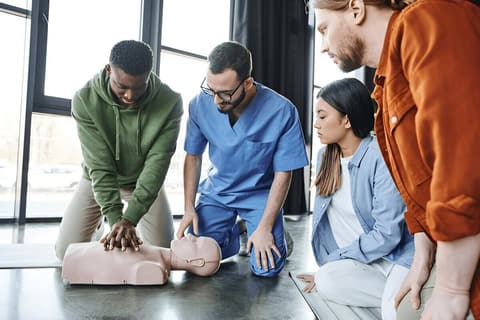
When someone collapses at work, the minutes before an ambulance arrives belong to whoever is standing nearby. Our CPR certification training exists to make sure that person knows what to do and has done it before — on a manikin, with a coach correcting depth, rate and hand position until it is right.
Classes follow American Heart Association guidelines and end with an AHA certification card valid for two years. We teach at your facility, so employees learn where the AED cabinet actually hangs and how to direct a coworker to call 911 and meet the responders at the door.
Course Options
We combine modules to match who you are training. Ask us which fits; we will not sell you more than the role needs.
-
Adult CPR and AED
Recognizing cardiac arrest, high-quality chest compressions, rescue breaths with a barrier, AED use and choking relief for adults.
-
First aid
Bleeding control, burns, sprains and suspected fractures, allergic reactions, diabetic and seizure emergencies, and heat or cold illness.
-
Child and infant CPR
Technique changes for smaller bodies, infant choking relief and pediatric AED use — common for schools, daycares and youth programs.
-
Renewal
For people whose AHA card is nearing its two-year date: a skills refresh plus any guideline updates since the last class.
What Participants Practice
Every skill below is performed, not just watched.
- Checking scene safety and responsiveness, and calling for help and an AED
- Chest compressions at the correct depth and rate, with full recoil
- Giving breaths with a pocket mask or barrier device
- Powering on an AED trainer, placing pads and following the prompts
- Switching compressors without long pauses during team CPR
- Relieving choking in a responsive and an unresponsive person
- Controlling bleeding with direct pressure and, where included, a tourniquet
Does Your Workplace Need CPR and First Aid Training?
OSHA does not have a general rule that every employer must train staff in CPR. It does require, under 29 CFR 1910.151(b), that a person adequately trained to render first aid be readily available when there is no infirmary, clinic or hospital in near proximity to the workplace. Some OSHA standards for specific work, such as electrical power generation and certain confined space operations, also call for CPR-trained personnel. OSHA explains the details on its medical and first aid page.
Beyond OSHA, many jobs carry their own requirements through state licensing, insurers or employer policy — childcare, coaching, healthcare, security and education are common examples. Confirm the rules that apply to your roles and your state plan; we are glad to help you think it through. Our article on workplace CPR and AED training requirements covers the common questions.
Turning Certified Employees Into a Response Team
A stack of AHA cards in a filing cabinet is not the goal. The goal is that a cardiac arrest on second shift in the back warehouse gets the same fast response as one in the front office. A few planning decisions make the difference, and we cover them with you while we are on site.
Spread trained people across shifts and areas
Training only the day-shift office staff leaves gaps. Look at where people work alone, where nights and weekends run thin, and where response would take longest, then make sure each area has someone certified.
Know where the AED lives — and that it works
During class we use your actual AED location in scenarios. Afterward, assign someone to check pads and batteries on a schedule, and keep the cabinet visible and unlocked during working hours.
Practice the hand-off
Decide who calls 911, who meets responders at the door and who brings the AED and first aid kit. Rehearsing those roles once a year turns a crowd of bystanders into a team.
Where You Can Take the Class
| Option | Best for | Certification |
|---|---|---|
| Onsite at your facility | Teams of any size who want training in their own space | AHA card issued the same day |
| Instructor-led classroom | Groups that prefer focused time away from the floor | AHA card issued the same day |
| Online CPR course | Awareness, refreshers between certifications, remote staff | Completion record; not an AHA card on its own |
Hands-on skills must be demonstrated to an instructor for AHA certification. The online CPR course is useful knowledge training but does not replace the skills check.
Who Teaches Your Class
Our instructors respond to real emergencies, not just teach about them. Founder Brandon S. Beaver spent roughly 14 years in safety leadership at Niagara Bottling and serves today as an Emergency Medical Responder and firefighter with the Chidester, Arkansas Fire Department. Travis E. Beaver served as a U.S. Navy Hospital Corpsman and has worked as a firefighter and Emergency Medical Responder since 2022.
That background shows in the details: how to keep compressions going while someone fetches the AED, what to say to a panicking bystander, and why the first person who gets on the chest matters more than the most qualified person in the building.
Scheduling CPR Training for a Group
-
Share the basics
Number of participants, which modules you need, and whether any staff are renewing existing cards.
-
Choose dates and shifts
We can run consecutive sessions so coverage on the floor never drops.
-
Prepare the room
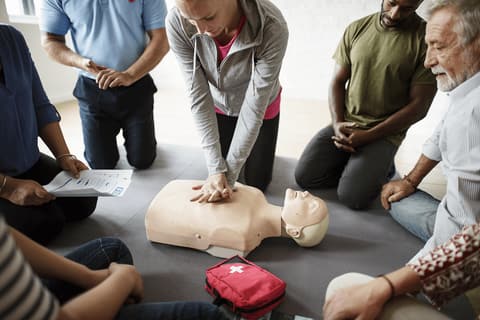
Floor space to kneel, tables, power and a way to darken the room for any video. We bring manikins, AED trainers and barriers.
-
Certify and track
Cards are issued the same day; we give you a roster so you can plan renewals two years out.
CPR Certification FAQs
How long is AHA CPR certification valid?
Two years from the class date. Plan renewal before the card expires so there is no gap; our guide on CPR certification renewal walks through the timing.
Is there a test?
Yes — participants demonstrate skills to the instructor, and some course versions include a short written portion. We coach everyone until they are ready.
What if someone struggles with the skills check?
That is what the practice time is for. Instructors work one on one with anyone whose compressions are too shallow or too slow, and we talk through accommodations ahead of time for anyone with knee or back limitations. Nobody is rushed through just to finish on time.
What should participants wear?
Comfortable clothes they can kneel in. Everything else is provided.
Do you offer group discounts?
Yes. Group pricing applies from 10 participants. Request a quote with your headcount.
Can CPR be paired with other training?
Often. Many clients combine CPR/AED with active shooter training or bloodborne pathogens training in the same visit.