
AVIRT Explained
What Is AVIRT? Active Violence Immediate Response Training Explained
AVIRT is a short, hands-on HSI course that teaches people with no law enforcement or medical background how to recognize, respond to and survive an act of violence where they work, and how to keep an injured person alive until help arrives.
- HSI Authorized Training Center
- AHA Certified Instructors
- OSHA Outreach Training
- Navy Corpsman Instructor
- Onsite & Online Training
What Is AVIRT, in One Paragraph?
So, what is AVIRT? The letters stand for Active Violence Immediate Response Training. It is a curriculum from the Health & Safety Institute (HSI), designed for the general workforce rather than for officers or medics. In roughly four hours, participants learn to notice warning signs, decide quickly what to do when violence breaks out, communicate with coworkers and 911, and control life-threatening bleeding using Stop the Bleed methods.
The word that matters most is immediate. Police and EMS can be minutes away, and in many rural or industrial settings much longer. The people already on scene are the ones who decide whether a door gets locked, whether a hallway gets cleared, and whether a wounded coworker gets a tourniquet. AVIRT is built around that gap.
Breaking Down the AVIRT Name
| Letter | Word | What it means in class |
|---|---|---|
| A | Active | The threat is happening now, not a hypothetical policy discussion. |
| V | Violence | Covers any violent attack, not only shootings: edged weapons, vehicles, assaults. |
| I | Immediate | Focus on the first minutes, before trained responders are on scene. |
| R | Response | Specific actions: move, secure, defend, call, treat. |
| T | Training | Practiced with your hands and in scenarios, not just watched on a screen. |
What an AVIRT Course Actually Teaches
The content falls into four connected blocks. Each one builds on the last, and all of them are practiced rather than simply described.
Situational awareness and recognition
Participants learn what pre-attack behavior can look like, how to recognize sounds and crowd movement that signal trouble, and why hesitation while waiting for confirmation costs time. The goal is a habit of noticing exits, barriers and people, not paranoia.
A decision framework for the first minutes
Rather than a fixed sequence, AVIRT gives people a way to weigh their options in real time: get out if there is a safe path, secure and conceal if there is not, and defend with full commitment only when there is no other choice. It also covers what to do when law enforcement arrives, such as keeping hands visible and following commands.
Hemorrhage control
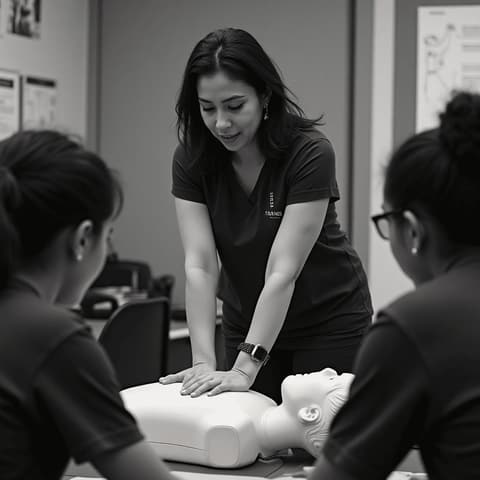
Uncontrolled bleeding can kill within minutes. Students apply tourniquets, pack wounds and hold direct pressure on training aids until the technique is familiar. This is the same skill set taught in Stop the Bleed, which we explain further in our article on bleeding control training.
Scenario-based drills
Short drills put the pieces together in your actual workspace. Instructors adjust the pressure and complexity to the group, so a front-office team and a plant maintenance crew each get realistic practice.
How AVIRT Relates to Other Courses
-
Run-hide-fight awareness
AVIRT keeps the core idea of escape, conceal, defend, but adds decision practice and medical skills. See our AVIRT versus traditional training comparison.
-
CPR and AED
CPR addresses cardiac arrest; AVIRT addresses traumatic bleeding. Many teams hold both, through our AHA CPR certification classes.
-
Online violence awareness
The self-paced violence in the workplace course covers prevention and reporting and makes a good pre-class primer.
Who Teaches AVIRT at Safety Is A Mindset
Classes are led by people who have treated real patients. Brandon S. Beaver founded the company after roughly 14 years in safety leadership at Niagara Bottling and now serves as a firefighter and Emergency Medical Responder with the Chidester, Arkansas fire department. Travis E. Beaver served on active duty as a U.S. Navy Hospital Corpsman from 2016 to 2022, continues in the Navy Reserve, and teaches TCCC.
Because the company is an HSI Authorized Training Center, the course follows the published HSI curriculum, and every participant who completes it receives HSI documentation.
Is AVIRT Right for Your Organization?
AVIRT tends to be a strong fit if several of these describe your workplace:
- Members of the public, students or patients walk in without screening
- Staff work alone, at night, or in buildings with many entrances
- The nearest trauma center or ambulance station is a long drive away
- You have an emergency action plan but employees have never practiced it
- Your first-aid team knows CPR but has no training in severe bleeding
Common Questions About AVIRT
What does AVIRT stand for?
Active Violence Immediate Response Training, an HSI course for employees and the public.
Is AVIRT just a new name for active shooter training?
No. It covers violence of all kinds, adds a practiced decision process and teaches hands-on bleeding control, which most awareness-only programs leave out.
How long does the class last?
About four hours. We usually run it at your facility so scenarios use your real rooms and exits.
Do participants need any medical background?
None. The bleeding control portion starts from zero and is designed for laypeople.
Where can we see sector-specific versions?
Our AVIRT training program hub lists every industry we tailor the course for.