Emergency Preparedness
Stop the Bleed: Why Hemorrhage Control Training Can Save Lives
Most workplaces plan for cardiac arrest. Far fewer plan for severe bleeding. Here is the case for bleeding control training, and a framework for building the program.
The gap in most emergency plans
Walk through a typical facility and you will find fire extinguishers, first aid cabinets and, increasingly, an AED. What you often will not find is any plan for an employee whose leg has been torn open by a piece of equipment. Severe external bleeding is one of the few injuries where the outcome is decided in minutes, and where the person who can change it is almost always a bystander.
That is the reasoning behind bleeding control training. The techniques themselves are simple enough to teach to anyone in a short session. What saves lives is having trained people and the right equipment in the right places before the injury happens.
Why hemorrhage control training saves lives
The lessons come largely from military medicine. Battlefield experience showed that many deaths from limb wounds were preventable with early tourniquet use and wound packing. After high-profile civilian mass-casualty events, surgeons and emergency medical leaders concluded the same principle applied at home, and the Stop the Bleed campaign was created to put those skills in the hands of the public.
Time is the enemy
A major bleed can incapacitate a person well before EMS arrives. During a violent incident, paramedics may also be held back until police declare the area safe. In both cases, the only realistic intervention comes from the people already there.
The skills are learnable
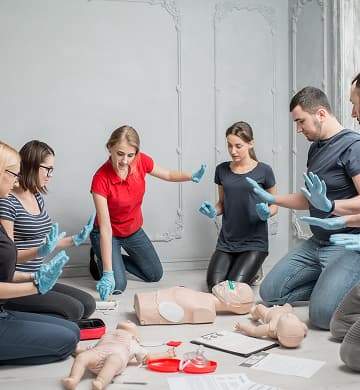
Direct pressure, wound packing and tourniquet application do not require clinical knowledge. They require practice. People who have applied a tourniquet in training are far more likely to use one correctly under stress than people who have only watched a video.
It covers more than one kind of emergency
The same skills apply to machine injuries, vehicle incidents, falls, broken glass and violence. That breadth makes hemorrhage control one of the most versatile emergency skills an employer can invest in.
Planning a workplace bleeding control program
Treat bleeding control like any other safety program: assess, equip, train, maintain and review.
-
Assess where serious bleeding could occur
List operations with blades, saws, presses, glass, sheet metal, heavy vehicles or public access. Note isolated areas and long distances from the nearest door EMS would use.
-
Decide who will be trained
At a minimum, train your existing first aid and CPR responders, supervisors and security staff on every shift. Many employers extend training to all employees in high-hazard areas.
-
Choose and place kits
Mount kits where they can be reached quickly from high-risk zones and gathering areas, often next to AEDs so responders learn one location.
-
Write it into your plan
Add bleeding emergencies to your emergency action plan: who calls 911, who brings the kit, who meets EMS and who handles bloodborne pathogen follow-up.
-
Maintain and refresh
Inspect kits on a schedule, replace used or expired items and repeat hands-on practice periodically so skills stay usable.
Kit placement guidelines
There is no universal formula for how many kits a site needs. These general guidelines help you think it through.
| Consideration | What to ask |
|---|---|
| Travel time | Can a responder reach the nearest kit and return to any work area within a minute or two? |
| Hazard zones | Is there a kit near each high-risk process, not just in the main office? |
| Visibility | Is the kit clearly signed and unlocked during working hours? |
| Pairing | Is it located with the AED or first aid cabinet so people learn one spot? |
| Mobile crews | Do vehicles and remote crews carry their own kits? |
| Public areas | Are kits accessible in lobbies, cafeterias and other places where people gather? |
What a workplace kit typically contains
- At least one commercial tourniquet, with more for larger or higher-risk sites
- Compressed or hemostatic gauze for wound packing
- A pressure or trauma bandage
- Nitrile gloves and trauma shears
- A permanent marker for recording tourniquet time
- Simple instruction cards as a memory aid for trained users
How we teach it
Safety Is A Mindset is an HSI Authorized Training Center, and Stop the Bleed hemorrhage control is built into our AVIRT programs and taught alongside CPR, AED and first aid certification. Our instructors bring real field experience: our founder serves as an Emergency Medical Responder and firefighter, and Travis Beaver is a former Navy Hospital Corpsman and TCCC instructor. In class, every participant applies tourniquets and packs wound trainers until they can do it without prompting.
Because bleeding emergencies are tied to your physical site, we prefer to teach them at your facility, where we can review kit locations and EMS access as part of the session.
Measuring whether the program works
You will hopefully never test the program on a real injury, so use indirect measures. Track how many people on each shift have current hands-on training. During monthly or quarterly inspections, confirm every kit is in place, sealed and in date. Add a bleeding scenario to at least one drill each year and time how long it takes a responder to reach the casualty with a kit. Ask a few employees at random where the nearest kit is. If the answers are slow or uncertain, you have found your next improvement before an emergency found it for you.
Do not neglect the everyday injuries
Planning for catastrophic bleeding should not crowd out first aid for the cuts, burns and strains that happen far more often. A balanced program covers both, with bleeding control layered on top of a solid first aid foundation.
Employer questions about bleeding control
Is bleeding control training required by OSHA?
OSHA's first-aid standard requires adequately trained responders where medical care is not close by, and training should match your hazards. Where severe bleeding is a realistic risk, hemorrhage control is a sensible part of that training.
Should every employee be trained?
Training everyone gives the best coverage. At minimum, make sure trained responders are present on every shift and in every high-risk area.
Do kits expire?
Some components, such as hemostatic gauze, carry expiration dates. Add kits to your regular inspection routine.
What should employees read before class?
Our employee guide to Stop the Bleed is a good introduction.