CPR & First Aid
Stop the Bleed for the Workplace: What Employees Should Know
A saw slips, a sheet of glass breaks, a forklift pins a leg. Stop the Bleed skills for employees are about what you do in the minutes before help arrives.
Why this is your job, too
When someone at work is bleeding heavily, the person most likely to help is not a paramedic. It is whoever is standing closest. Severe bleeding from an arm or leg can become life-threatening quickly, and even a fast ambulance needs time to arrive, find the right entrance and reach the injured worker.
Stop the Bleed is a national awareness campaign, backed by the American College of Surgeons, that teaches ordinary people to control serious bleeding. You do not need medical training to learn it. This article is a practical overview for employees: what to look for, what to do and what the kit on the wall is for. It is not a substitute for a hands-on class, which is where these skills actually take hold.
How to recognize life-threatening bleeding
Not every cut is an emergency. Treat bleeding as life-threatening if you see any of these:
- Blood that is spurting or pulsing from the wound
- Blood that keeps flowing steadily and will not slow down
- Blood pooling on the floor or soaking through clothing quickly
- A partial or complete amputation of a limb or finger
- Bleeding along with confusion, pale skin or loss of consciousness
What to do, in order
The sequence you learn in class follows this pattern. Your instructor will show you exactly where and how hard to press.
-
Make sure you are safe
Shut down or stay clear of the machine, traffic or other hazard that caused the injury. Put on gloves from the first aid or bleeding-control kit if you can do so quickly.
-
Call 911, or point at someone and tell them to
Be specific: "You, call 911 and send someone to the front gate." Ask another person to bring the bleeding-control kit and AED.
-
Find the source and press hard
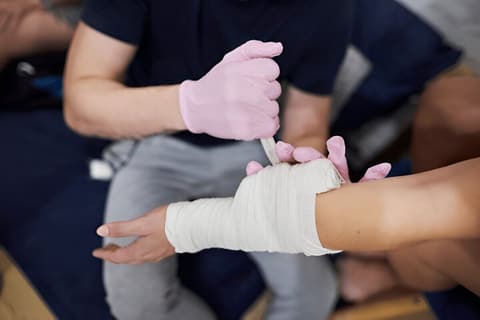
Expose the wound, put gauze or any clean cloth on it and push down firmly with both hands. Keep pressing. Do not lift it to check.
-
Use a tourniquet on a limb if pressure is not enough
For heavy bleeding from an arm or leg, place the tourniquet a few inches above the wound, not over a joint, tighten until the bleeding stops and note the time.
-
Pack wounds where a tourniquet will not fit
For deep wounds at the shoulder, armpit, groin or neck, push gauze firmly into the wound until it is full, then hold strong pressure on top.
The three techniques, explained
Classes focus on three skills. Here is what each one feels like when you do it for the first time.
Direct pressure
This is the simplest and the most tiring. You lock your arms, lean your body weight over the wound and hold. Most people press too lightly at first. In class you practice on a model that shows you whether your pressure is enough.
Tourniquets
A commercial tourniquet has a strap, a windlass rod and a clip to lock it in place. Applying one correctly is tighter and more painful for the injured person than most people expect. That pain is normal. A loose tourniquet can make bleeding worse, which is why practicing on yourself and a partner matters so much.
Wound packing
Packing means feeding gauze directly into a wound, using your fingers to push it deep toward the source of bleeding, and keeping going until the cavity is full. It feels uncomfortable to do and unfamiliar to watch. Training on a realistic wound model is the only real way to get past that hesitation.
What is in the bleeding-control kit
Many workplaces now mount bleeding-control kits beside first aid cabinets or AEDs. A typical kit contains one or more tourniquets, compressed or hemostatic gauze for packing, a pressure bandage, gloves, trauma shears to cut away clothing and a marker to record the tourniquet time. Find out where the nearest kit is to your work area today. If you cannot find one, ask your supervisor. The kit only helps if someone can reach it fast.
Where workplace bleeding injuries come from
People often connect Stop the Bleed with violent incidents, and it is a core part of our AVIRT course. But at work, accidents are the more common cause: blades and saws, sheet metal and glass, crushing injuries from equipment, falls onto sharp edges and vehicle incidents in yards and docks. That is why bleeding control belongs alongside CPR and first aid training on any site with machinery, tools or traffic. Workers in manufacturing and construction are obvious candidates, but an office kitchen knife or a broken window can cause serious bleeding too.
After the emergency
When EMS arrives, tell them what happened, what you did and what time the tourniquet went on. Do not loosen or remove it yourself. Afterward, wash any blood off your skin, report the exposure to your supervisor and follow your company's bloodborne pathogens procedures. It is also normal to feel shaken after helping in a serious emergency; talk to someone about it.
Employee questions about Stop the Bleed
Will I get in trouble if I use a tourniquet wrong?
Every state has Good Samaritan protections for people who help in good faith, though details vary. Training is the best way to act correctly and confidently.
Can I improvise a tourniquet with a belt?
Improvised tourniquets often fail to stop arterial bleeding. Use firm direct pressure while someone brings a commercial tourniquet.
Is CPR training enough?
No. CPR addresses a stopped heart. Bleeding control is a separate skill that complements CPR and first aid.
How do I get trained?
Ask your employer about an onsite class. Stop the Bleed skills are taught in our AVIRT and first aid programs.