CPR & First Aid
CPR and AED Training: Why Every Workplace Should Be Prepared
When someone collapses at work, the people nearby decide what happens next. CPR and AED training for the workplace turns bystanders into the first link of care.
A collapse in the break room
Picture an ordinary afternoon. A maintenance technician walks into the break room, says he feels lightheaded and drops to the floor. He is not responding and his breathing is irregular gasps. Someone shouts for help. Someone else dials 911. Then everyone looks at each other.
That pause is the reason CPR and AED training for the workplace matters. Sudden cardiac arrest is an electrical failure of the heart: it stops pumping effectively and blood stops reaching the brain. It can strike people with no known heart condition, at any age, in any job. Paramedics will come, but they cannot be standing in your break room the moment it happens. Whatever the coworkers do in the first few minutes shapes the outcome far more than anything that happens later.
The chain of survival, in workplace terms
The American Heart Association describes cardiac arrest care as a chain of linked actions. The first three links happen before EMS arrives, which means your employees own them.
-
Recognize and call
Spot an unresponsive person who is not breathing normally, send someone to call 911 and send someone else for the AED. Gasping is not normal breathing, and trained responders learn to treat it as a sign of arrest.
-
Start high-quality CPR
Push hard and fast in the center of the chest with minimal interruptions. Compressions keep some oxygenated blood moving to the brain while the heart cannot.
-
Defibrillate early
An AED analyzes the heart rhythm and delivers a shock only if one is advised. The sooner it is applied, the better the odds that a shockable rhythm can be corrected.
-
Hand off to professionals
Guide EMS to the patient, report what happened and what was done, and let advanced care take over. Hospital treatment and recovery complete the chain.
Why the business case is stronger than it looks
Most leaders approve CPR training because it is the right thing to do, and that is reason enough. But the benefits reach further than a single emergency.
Confidence spills into other emergencies
People who have practiced a structured response to cardiac arrest tend to handle choking, fainting and serious injuries more calmly too. The habit of checking the scene, assigning tasks and calling clearly carries over.
Customers and visitors are covered too
Retail floors, hotel lobbies, school gyms and office reception areas see a steady flow of people who are not your employees. A trained staff member is often the only responder nearby when a visitor collapses.
It signals that safety is real
Employees notice when an employer invests time in skills that protect them personally. A practical, hands-on class tends to land better than another policy acknowledgment, and it supports the wider safety culture you are trying to build.
AED program basics
Buying an AED is the easy part. A workplace AED program is what makes the device useful on the day it is needed.
- Placement: mount AEDs in visible, unlocked spots along main walking routes, close enough that a responder can retrieve the device and return quickly. Large or multi-level sites usually need more than one.
- Signage: mark the cabinet clearly and include AED locations on evacuation maps and new-hire orientation.
- Inspection: assign a named person to check the status indicator, battery and pad expiration dates on a regular schedule, and log each check.
- Spare supplies: keep a spare set of pads, a razor, gloves and a barrier mask with the unit.
- Trained users: make sure every shift has people who have practiced with an AED trainer, not just read the label.
- Local rules: confirm any state registration, notification or medical oversight requirements. Our article on CPR/AED training requirements explains where those rules come from.
- Post-use review: after any use, restock, download data if the manufacturer recommends it and debrief the responders.
What employees learn in a workplace CPR/AED class
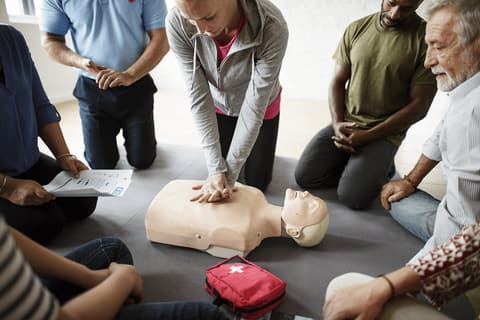
Our American Heart Association CPR and AED courses are built around practice, not lecture. Participants work on feedback manikins to find the right compression depth and rate, rotate through rescuer roles, place AED pads on trainers and follow the voice prompts from start to finish. Adult techniques are standard, and child and infant skills are added when your workplace serves families or children. Participants who pass receive an AHA card valid for two years, issued the same day.
When we teach onsite at your facility, we use your building in the scenarios: where the AED actually hangs, which door the ambulance will use and who meets the crew. Those details are what make the first real response feel familiar instead of foreign.
Many employers combine CPR with first aid, because cuts, burns, fractures and heat illness are far more frequent than cardiac arrest. For the wider workforce, a self-paced online CPR awareness course keeps the basics fresh between hands-on certifications.
Keeping skills from fading
CPR is a physical skill, and physical skills fade without use. Short refreshers help: a two-minute compression drill at a safety meeting, a quarterly walk to each AED to confirm everyone knows where it is, or a mock call during a fire drill. Track certification dates so that cards are renewed before they lapse rather than after. Our renewal guide offers a simple tracker layout.
CPR and AED questions from employers
Can an untrained person use an AED?
AEDs are designed with voice prompts so a bystander can use one, and they will not shock a rhythm that does not need it. Training removes hesitation and speeds up pad placement, which is why we recommend it for anyone on your responder list.
Do we need an AED if the fire station is close by?
Even a short EMS response includes travel, finding the right entrance and reaching the patient. An on-site AED in trained hands closes that gap.
Who should be trained first?
Start with people who are always on site across every shift, such as supervisors, security and front-desk staff, then expand coverage to each work area.
Does CPR training include first aid?
They are separate certifications that are often taught together. We can combine them in one onsite session.
Keep reading
- Does your business need CPR/AED training?OSHA 1910.151, industry rules and state AED laws.
- Hemorrhage control trainingThe other time-critical skill for workplace responders.
- Certified CPR training coursesAHA CPR, AED and first aid for groups.
- In-person safety trainingHow instructor-led sessions are scheduled and delivered.