CPR & First Aid
Does Your Business Need Workplace CPR/AED Training? The Requirements Explained
A plain-language look at workplace CPR/AED training requirements: what OSHA mandates, where industry rules go further, and why state law and contracts often decide the question.
The short answer on workplace CPR/AED training requirements
Employers ask us some version of this question every week: is CPR and AED training legally required for my workplace? Federal OSHA does not have a single rule that says every business must certify its staff in CPR. What it does have is a first-aid standard that applies to most general industry employers, a handful of industry standards that name CPR specifically, and a general duty to protect workers from recognized hazards. On top of that sit state laws, insurers and customer contracts.
So the honest answer is "it depends," but it depends on things you can check. This article walks through each layer so you can decide where your organization stands. It is general guidance, not legal advice; confirm the details with your state plan, insurer or counsel.
What OSHA 1910.151 requires
The general industry standard on medical services and first aid, 29 CFR 1910.151, is the starting point for most employers.
The "near proximity" test
Paragraph (b) says that when there is no infirmary, clinic or hospital in near proximity to the workplace, a person or persons must be adequately trained to render first aid, and first-aid supplies must be readily available. OSHA has interpreted near proximity in terms of response time rather than miles. Where serious injuries such as stopped breathing, cardiac arrest or severe bleeding are possible, its interpretation letters point to a response measured in a few minutes. Very few workplaces can count on outside care arriving that fast, which is why most employers end up needing trained people on site.
Where CPR fits
The standard says "first aid," not CPR. OSHA's own guidance, however, treats CPR and AED skills as part of an adequate first-aid program when cardiac emergencies are a realistic possibility, and it expects training to include hands-on practice. Paragraph (c) adds a separate requirement for quick-drenching or eye-flushing facilities where workers handle injurious corrosive materials.
Construction sites
Construction has a parallel rule at 29 CFR 1926.50. It also ties the requirement to whether medical care is reasonably accessible, and it calls for a person with a valid first-aid certificate to be available at the worksite when it is not.
Industry standards that name CPR directly
Some OSHA standards go beyond the general first-aid rule. If your work falls under one of these, CPR training is not optional for the people involved.
| Standard | Who it affects | What it asks for (in general terms) |
|---|---|---|
| 1910.269 | Electric power generation, transmission and distribution | Trained first-aid and CPR responders available for field crews and at fixed work locations |
| 1910.146 | Permit-required confined space rescue | Rescue team members trained in first aid and CPR, with at least one holding current certification |
| 1910.266 | Logging operations | First-aid and CPR training for each employee |
| 1910.1030 | Any job with occupational exposure to blood | Bloodborne pathogens training for designated first-aid responders |
This is a summary, not the regulatory text. Read the current standard on osha.gov for exact wording and exceptions.
Is a business required to have an AED?
Federal OSHA does not generally require AEDs, although it encourages employers to consider them as part of a first-aid program. The more likely source of an AED requirement is your state. Every state has some form of AED legislation, and the rules vary widely. Common themes include:
Placement mandates for specific settings, which in some states cover schools, health clubs, certain public buildings or large venues. Training expectations for people expected to use the device. Registration or notification so local EMS knows where AEDs are located. Maintenance duties such as checking batteries and pad expiration dates. Most states also extend Good Samaritan or civil-immunity protection to trained users and to organizations that follow the state's program rules.
Because these details change and differ from state to state, check your own state statute or ask your insurer before assuming you are, or are not, covered. Our guide to building an AED program covers the practical side once you decide to add one.
Other places a CPR requirement can come from
Even where no law applies, many employers find the decision has been made for them by someone else:
- General contractor or owner safety requirements written into a subcontract
- Insurance carrier loss-control recommendations
- Customer or vendor audits that ask for proof of trained responders
- Licensing rules for childcare, healthcare, fitness and similar regulated businesses
- Your own written emergency action plan, if it assigns first-aid duties to named roles
How many employees need CPR certification?
No federal rule sets a ratio. The practical test is whether someone trained can reach any worker, on any shift, within moments. Walk through each building and shift and ask who responds, who backs them up when they are on vacation, and how long it takes to get from the far end of the floor to the AED cabinet.
Many employers end up with a core group of responders per shift and per area, plus a few extra people for coverage. Others train everyone, especially in high-hazard or public-facing settings, because a larger pool of capable people removes the guesswork. Whatever you choose, write it down and keep the roster current, since staffing changes can quietly erase your coverage.
What counts as adequate training
OSHA does not certify CPR courses, but it expects training to be appropriate for the hazards and to include hands-on skills practice. Online-only programs also fall short of the American Heart Association's own standard, which requires an in-person skills check for certification.
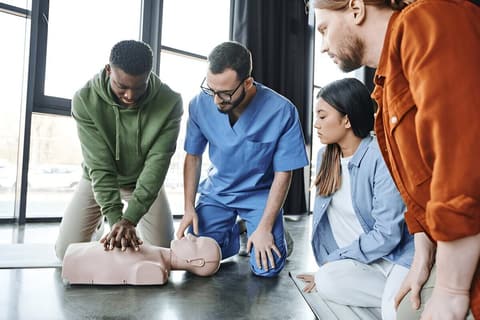
Our AHA CPR, AED and first aid certification classes include manikin practice, AED trainer work and a card issued the same day, valid for two years. When we teach at your facility through our onsite training service, responders rehearse with your actual AED location and entrances. Pair that with bloodborne pathogens training for anyone assigned first-aid duties.
Workplace CPR requirement questions
Does OSHA require CPR training in every workplace?
No. OSHA requires trained first-aid personnel when medical care is not in near proximity, and certain standards such as 1910.269 and 1910.146 name CPR specifically. For most other employers, CPR becomes necessary through hazard assessment, state rules or contracts.
Does OSHA require an AED?
Not as a general rule. State laws, licensing rules and insurers are the more common sources of AED requirements.
Is an online CPR certificate enough?
For AHA certification, no. A hands-on skills session is required. Online modules are useful for awareness and refresher knowledge between certifications.
How often does CPR training need to be repeated?
AHA cards are valid for two years. See our article on CPR certification renewal for tracking tips.
Related reading and courses
- CPR and AED training: the business caseCardiac arrest response, the chain of survival and AED program basics.
- CPR certification renewalHow long cards last and how to keep a team current.
- Emergency preparedness checklistPlan, roles, equipment and drills in one list.
- Online first aid overview courseSelf-paced refresher knowledge for the wider workforce.