
Online Course · Emergency Response
Cardiopulmonary Resuscitation (CPR): Online Course
When someone collapses in sudden cardiac arrest, what bystanders do in the first minutes matters enormously. This online CPR course teaches employees to recognize the emergency, call for help, push hard and fast, and use an AED.
What the Online CPR Course Teaches
Sudden cardiac arrest happens when the heart's electrical system fails and it stops pumping effectively. Without blood flow, the brain is quickly starved of oxygen. CPR keeps some blood moving, and an AED can restore a normal rhythm. Together they give the person the best chance until EMS arrives.
Our online CPR course covers the knowledge side of that response for adult victims, with an introduction to children and infants. It is a strong way to build awareness across a whole workforce and to prepare people for a hands-on skills session.
The Chain of Survival
The course is organized around the links that most improve a person's chance of surviving cardiac arrest.
-
Recognize and call
Spot unresponsiveness and abnormal breathing, then call 911 and get an AED.
-
Early CPR
Start chest compressions immediately; do not wait for certainty.
-
Rapid defibrillation
Use the AED as soon as it arrives and follow its voice prompts.
-
Advanced care
Hand over to EMS with a clear summary of what happened.
-
Recovery
Hospital care and longer-term recovery, including support for responders.
Adult CPR at a Glance
-
Make sure the scene is safe
Check for hazards such as traffic, electricity or machinery before approaching.
-
Check and call
Tap and shout. If there is no response and no normal breathing, call 911 and send someone for the AED.
-
Compress
Hands in the center of the chest, push at least 2 inches deep at 100 to 120 compressions per minute, allowing full recoil.
-
Breathe if trained
Give 2 breaths after every 30 compressions, or continue hands-only CPR if you are not trained or willing.
-
Use the AED
Turn it on, attach the pads as shown and follow the prompts, minimizing pauses in compressions.
Online Learning and Certification
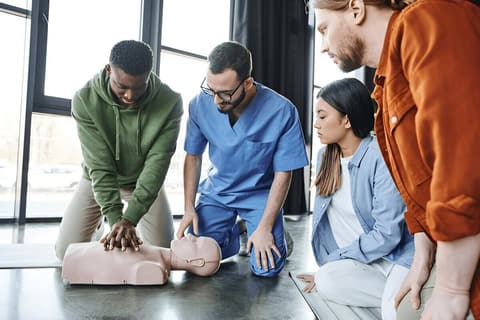
Reading and watching are not the same as doing. Compression depth, rate and recoil are physical skills, and the major certifying bodies require a hands-on skills check before issuing a CPR card. This online course gives learners a completion record; it does not by itself award an American Heart Association certification.
For certification, we deliver AHA CPR and AED training at your facility, with manikins and AED trainers, and cards valid for two years. Many employers assign the online course first so classroom time can focus on practice. Our article on CPR renewal explains how often to retrain.
CPR and Workplace Requirements
OSHA has no general rule requiring every employer to train staff in CPR. Some standards, such as those for electrical power generation work and permit-required confined space rescue, do call for CPR-trained personnel, and OSHA's first aid standard requires trained responders when medical help is not in near proximity. State rules, contracts and insurers may add more. Our guide to workplace CPR and AED requirements walks through the details.
Who Should Take This Course
- Any employee who wants to be ready to help a coworker, customer or family member
- Designated responders preparing for hands-on certification
- Supervisors at sites with AEDs who should understand how they are used
- Teachers, coaches, fitness and hospitality staff
- Utility, construction and industrial workers at remote locations
Online CPR FAQs
Can I be CPR certified completely online?
Not with a nationally recognized card such as AHA. A hands-on skills session is required. This course prepares you for it and records your completion.
Is hands-only CPR effective?
For adults who collapse suddenly, hands-only CPR by a bystander is far better than no CPR, and it is easier to start without hesitation.
Could I hurt someone with an AED?
AEDs analyze the heart rhythm and only advise a shock when one is needed. Follow the prompts and make sure nobody touches the person during a shock.
What if I am afraid of doing it wrong?
Hesitation is the most common problem bystanders face. A person in cardiac arrest is clinically dead without help, so pushing hard and fast in the center of the chest can only improve their chances. The course and a later hands-on practice session are designed to build that confidence.